Last updated 2026-08-18
TL;DR
Entering walk-in cooler tech work in Alabama costs roughly $300 to $1,200 out of pocket. The core requirement is a federal EPA Section 608 Universal certification, which costs $149 for the exam and study kit. Alabama has no separate state HVAC license for refrigeration work. Most new techs spend another $150 to $500 on basic tools and 2 to 6 weeks on self-paced prep. Local business licenses apply if you go independent.
Do you need a license for walk-in cooler tech in Alabama?
No. Alabama does not require a state-level HVAC or refrigeration license to work on walk-in coolers. The Alabama State Board of Heating, Air Conditioning, and Refrigeration Contractors issues licenses only for contractors who pull permits and bid projects over $50,000. A technician working under a licensed contractor does not need a separate state card [1].
The only mandatory credential for a walk-in cooler tech is federal: EPA Section 608 certification. The Clean Air Act requires anyone who opens a refrigeration system to hold a Type I, II, III, or Universal card. An employer cannot legally cover you for refrigerant handling without your own certification card [2]. Most Alabama techs who handle walk-in coolers and freezers go straight for the Universal type. It covers small appliances (under 5 lbs of refrigerant), high-pressure systems (most self-contained and remote walk-in units), and low-pressure chillers. The test fee and study materials run about $149 through an EPA-approved test provider [3].
Local permits are a separate layer. Cities like Birmingham, Mobile, Huntsville, and Montgomery require business license or privilege license applications for anyone operating as an independent contractor. The Alabama Department of Revenue manages a state-level seller's permit if you sell parts or supplies directly to customers [4]. County and city requirements vary block by block. The City of Mobile, for example, charges an initial business license fee based on gross receipts tier with a minimum around $100 [5]. None of these are walk-in cooler "tech licenses." They are general business registrations.
If you are employed by a refrigeration company, you carry your EPA card and your employer carries the local business and contractor licenses. If you go solo as a one-person refrigeration repair service, you need the EPA card, a city business license, and a state seller's permit to buy refrigerant or parts tax-exempt for resale.
How much does walk-in cooler tech cost in Alabama?
The honest out-of-pocket cost for a new walk-in cooler tech in Alabama lands between $300 and $1,200. Nobody has a state-specific study on this trade entry cost. The numbers here come from actual EPA test provider pricing, tool kit retail prices current as of 2026, and Alabama local fee schedules.
The single unavoidable cost is EPA Section 608 certification. WalkInPath offers a one-time $149 package that includes the EPA 608 Universal exam, a study playbook covering the Type I, II, and III sections, and online proctoring. This is the lowest common entry price [3]. Some local community colleges in Alabama offer proctored exam sessions for around $75 to $120, but their prep materials cost extra. Budget $150 and a few weeks of self-study as the floor.
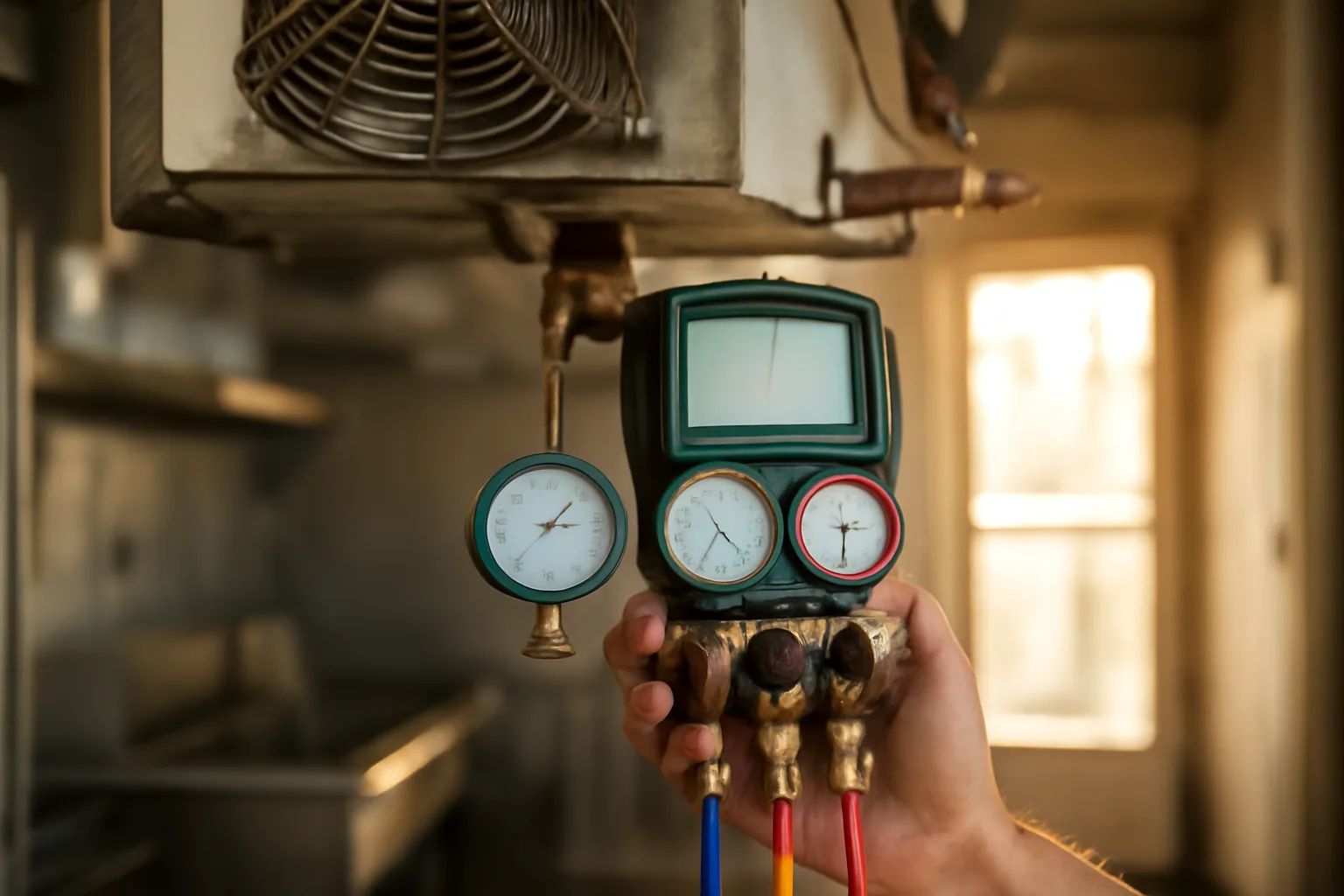
Tools run from $150 to $500 on the low end. A basic walk-in tech starter kit needs: a digital manifold gauge set ($80, $150), a refrigerant leak detector ($40, $120), a vacuum pump ($100, $300), basic hand tools including a 6-in-1 screwdriver, nut driver set, and adjustable wrenches ($40, $80), and a multimeter ($25, $60). Most new techs assemble this over 4 to 8 weeks. Experienced techs spend far more over years, but this gets you functional on day one.
If you go independent instead of working for a shop, local fees add another layer. A city business license in Alabama typically starts at $100 to $300 for small gross receipt brackets. A state seller's permit from the Alabama Department of Revenue has no upfront fee; it allows tax-exempt purchasing and requires monthly or quarterly sales tax filing [4]. Liability insurance is optional but common: a basic commercial general liability policy for a refrigeration tech runs $400 to $800 per year [6]. Most employed techs skip that cost; their employer covers it.
Here's how the typical startup path breaks down:
| Cost item | Low end | High end | Notes |
|---|---|---|---|
| EPA 608 Universal exam + study materials | $149 | $149 | One-time; WalkInPath package or similar |
| Basic tools (gauges, leak detector, pump, hand tools, meter) | $150 | $500 | Buy as you go; used market reduces this |
| Local business license (if solo) | $100 | $300 | Varies by city; see your city clerk |
| State seller's permit (if selling parts) | $0 | $0 | No fee; requires sales tax returns |
| Liability insurance (optional, solo path) | $400 | $800 / year | Depends on coverage and insurer |
Nobody needs all of this on day one. The realistic path: $149 for the EPA card, $200 for a manifold gauge set and a leak detector, then add a vacuum pump and hand tools over the next 4 to 6 paychecks. Alabama's cost of living is below the national average; tool prices at supply houses in Birmingham and Mobile run close to national online pricing [7].
How long does walk-in cooler tech take in Alabama?
From zero to EPA-certified and job-ready in Alabama takes 2 to 6 weeks of part-time self-study. There is no required apprenticeship, no Alabama state schooling mandate for refrigeration techs, and no minimum hour requirement to take the EPA 608 exam. You study the Core and Type I, II, III refrigerant handling rules, pass a 100-question multiple-choice test, and you are legal to work on walk-in cooler refrigerant circuits.
The EPA 608 Universal exam has four sections: Core (25 questions), Type I (25 questions), Type II (25 questions), Type III (25 questions). You need to pass the Core plus at least one type to get a certification. To get Universal, you pass all four. Most first-time test takers spend 10 to 20 hours studying over 2 to 3 weeks. The test itself takes roughly 2 hours under proctor supervision [2].
Alabama's Board of Heating, Air Conditioning, and Refrigeration Contractors says explicitly: "A technician who is employed by a licensed contractor is not required to be certified by the Board" [1]. That means once you have your EPA card, you can start working as a helper or a tech under a licensed contractor immediately. There is no waiting period for state approval. No apprenticeship card system like electrical or plumbing has. Walk-in cooler work is treated as refrigeration, not as structural HVAC construction requiring a contractor's license.
The timeline for going independent is longer. To register a business, get a city privilege license, and set up your Alabama seller's permit takes 1 to 3 weeks of paperwork depending on city processing speed [4][5]. The liability insurance quote and bind takes 2 to 5 business days [6]. None of this blocks you from working under an existing contractor while your independent setup processes.
For someone with zero HVAC background, a realistic path:
- Week 1 and 2: self-study the EPA Core and Type II material (Type II covers high-pressure systems, which is most walk-in equipment).
- Week 3: take and pass the EPA exam. If you only pass Type II, you are legal for walk-in cooler work. Come back for Universal later.
- Week 4: start applying to refrigeration and commercial kitchen service companies with your EPA card in hand.
What is the EPA 608 certification and why does it matter in Alabama?
EPA Section 608 certification is the federal refrigerant handling credential required by 40 CFR Part 82, Subpart F. The rule applies in every state, including Alabama. "No person may open a refrigeration system or work on the refrigerant circuit of a refrigeration appliance without holding a valid EPA certification card" [2]. This is not an Alabama rule. It is federal law enforced by the U.S. Environmental Protection Agency.
The Section 608 rule splits technician certification into four classifications:
- Type I: small appliances, typically 5 lbs or less of refrigerant. Covers most self-contained reach-in units.
- Type II: high-pressure appliances. This covers nearly all walk-in cooler and freezer systems, including split systems and self-contained walk-in units that use high-pressure refrigerant like R-404A or R-448A.
- Type III: low-pressure appliances, mainly centrifugal chillers in large commercial buildings.
- Universal: all three types.
For someone working exclusively on walk-in coolers, Type II is the minimum that covers the job. But Universal is the standard Alabama employers expect. Nearly every job listing for refrigeration techs in the state asks for "EPA Universal certified" because walk-in units can be self-contained (technically a Type I or Type II depending on charge size) or remote (Type II). Having just Type I leaves you unable to touch most walk-in equipment. Universal closes all gaps and costs the same at most test providers [3].
The EPA test proctor does not care what state you live in. The test is offered online through approved providers. You can take it from anywhere in Alabama with a reliable internet connection and a webcam for proctoring. WalkInPath's test fits that model: $149, online, self-paced study, proctored exam [3].
What tools does a walk-in cooler tech actually need starting out?
The honest starter tool list for a walk-in cooler tech in Alabama is shorter than the full kit a 10-year journeyman carries. You need enough to diagnose a refrigerant leak or a compressor failure and do a basic evacuation and recharge. Everything beyond that gets bought with on-the-job money.
The minimum set:
- Digital manifold gauge set with temperature clamps ($80, $150): measures suction and discharge pressure and calculates superheat and subcooling. Wireless models are convenient but pricier. A basic Testo or Fieldpiece 2-valve manifold works.
- Refrigerant leak detector ($40, $120): an electronic sniffing detector that picks up R-404A, R-448A, R-449A, and older R-22. Inficon and Bacharach make reliable entry-level units.
- Vacuum pump ($100, $250): a 3 CFM or 5 CFM two-stage pump can pull down walk-in linesets adequately. A cheap single-stage pump will not get you below 500 microns on a 100-foot lineset. Budget for two-stage.
- Micron gauge ($60, $120): a vacuum gauge that reads down to at least 50 microns. The manifold gauge's low-side compound gauge is not accurate enough for evacuation verification.
- Basic hand tools: 6-in-1 screwdriver, metric and SAE nut driver set, 10-inch adjustable wrench, service valve wrench, and a cordless drill. Roughly $40, $80 total if bought piecemeal.
- Multimeter with temperature probe ($25, $60): measures voltage, resistance, capacitance for compressor and fan motor diagnosis.
Alabama has no unusual tool requirements because of climate, but the high humidity in Mobile and Baldwin County makes leak detection harder outdoors: a good leak detector with heated diode sensor handles Gulf Coast humidity better than a corona discharge model. Expect to spend roughly $50 more on a leak detector that tolerates damp conditions [7].
Many Alabama supply houses (Johnstone Supply locations in Huntsville, Birmingham, Mobile; United Refrigeration outlets) sell starter combos. No apprenticeship tool list is mandated. You buy what your first employer doesn't provide. Some Alabama refrigeration shops issue tools to new techs; some expect you to bring your own gauge set and leak detector. Ask before you buy.
Alabama local licensing: what cities actually require
Alabama's local licensing for a walk-in cooler tech going independent is a business registration layer, not a technical qualification. The state does not test you on refrigeration knowledge at the municipal level. The city clerk wants a privilege or business license fee and your basic business information.
The three largest metro areas show the pattern:
- Birmingham: the City of Birmingham Finance Department issues business licenses based on gross receipts. The base minimum for receipts under $50,000 is roughly $100 to $150 depending on the NAICS code classification [8]. A home-based sole proprietor usually qualifies for the lowest tier.
- Mobile: Mobile County and the City of Mobile both have license requirements. The City of Mobile business license for a contractor or repair service is a flat fee that varies by trade category; repair services tend to fall in a $100 to $200 range [5]. Check with the Revenue Department.
- Huntsville: Huntsville's business license rates are set by the city council's schedule; a small service business typically lands in the $75 to $150 initial fee bracket [9].
Every city in Alabama has its own schedule. The Alabama League of Municipalities publishes a directory of license contacts, but the numbers are city-specific. Call your city hall's revenue division before you hang a shingle. The better path for most new walk-in cooler techs: work for a licensed contractor in your city for a year first. Learn the trade, save the tool money, and figure out the local rules from inside a company that already has them handled.
At the state level, the Alabama Department of Revenue requires a seller's permit (also called a sales tax license) if you buy refrigerant or parts for resale to customers. That permit is free to obtain and requires you to file a sales tax return monthly, quarterly, or annually depending on volume [4]. You cannot legally buy R-404A from a wholesaler without one if you intend to resell it. Most wholesalers in Alabama (R.E. Michel, Johnstone, Carrier Enterprise) will not sell to a walk-up tech without either a company account or a resale certificate.
Can you start without EPA certification and add it later in Alabama?
No, not legally. The EPA regulation prohibits touching refrigerant circuits without a valid certification card in your possession. An employer cannot "shadow" you: if you open a system, you need your own card. The EPA fines for uncertified handling are serious. The agency publishes an enforcement page detailing penalties up to $44,539 per day per violation [10]. Two out of three refrigeration supply houses in Alabama also check EPA card numbers before selling refrigerant in bulk cylinders [7].
Some Alabama shops hire helper positions that do not open refrigerant circuits. Those helpers run parts, clean condenser coils, change air filters, and assist with non-refrigerant electrical work. That path lets you earn wages while studying for the EPA exam. But "walk-in cooler tech" as a job title implies you handle refrigerant. Without the card, you are a helper, not a tech. The distinction matters for your pay rate. Alabama refrigeration helpers start around $14 to $17 per hour; certified techs start around $18 to $24 per hour [11].
The EPA 608 exam has no prerequisite hours, no apprenticeship clock. You can study for two weeks, take the test, and be fully legal. There is zero reason to delay it. The $149 cost is the cheapest business gatekeeping you will ever pay in the skilled trades. Every week you work without it, you are either limited to non-refrigerant work or operating illegally.
How Alabama's cost compares to other states for walk-in cooler tech startup
Alabama is among the lowest-cost states to enter walk-in cooler tech work. You skip the major licensing costs that hit techs in Florida, Georgia, Texas, and California. Alabama has no state HVAC technician license, no apprenticeship hour mandate, no exam beyond the federal EPA 608. In Florida, you need either a state Certified Contractor license or a Registered Contractor credential with county registration. In Georgia, you need a Conditioned Air Contractor license from the state Construction Industry Licensing Board which requires documented experience hours. In California, the EPA card alone is not sufficient; you must work under a C-20 contractor. Alabama's vacancy on state licensing makes it one of the simplest states for tech entry.
The table below compares startup requirements and costs across several states. Costs are estimated minimum out-of-pocket for EPA certification, tools, and required state licensing fees:
| State | EPA card cost | State license required for tech? | State license fee | Tool floor | Total minimum |
|---|---|---|---|---|---|
| Alabama | $149 | No | $0 | $150 | $299 |
| Arizona | $149 | No | $0 | $150 | $299 |
| California | $149 | C-38 or work under C-20 | Contractor license fees $450+ | $150 | $750+ |
| Florida | $149 | Certified or Registered contractor | $200, $500+ depending on path | $150 | $500, $800 |
| Georgia | $149 | Conditioned Air Contractor | $300 application fee plus exam fees | $150 | $600+ |
| Texas | $149 | Air Conditioning and Refrigeration Contractor | $115 exam fee plus license | $150 | $415+ |
Data from state licensing board fee schedules and EPA test provider pricing [3][12][13][14][15]. Tool costs assumed equal across states.
This lower barrier is a real advantage for someone getting started. It also means more people enter the trade in Alabama, which can compress entry-level wages slightly. Alabama refrigeration tech pay sits around the 25th percentile nationally when adjusted for cost of living, according to BLS data [11]. The trade-off is clear: easier entry, lower startup cost, but a more competitive market for new tech hires.
Where to take the EPA 608 exam in Alabama
You can take the EPA 608 exam from anywhere in Alabama that has a reliable internet connection, a webcam, and a quiet room. Most test providers including WalkInPath offer a fully online proctored option. A proctor watches through your webcam while you complete the 100-question Core + Type I, II, III exam. The test is closed-book, no notes, no phone. You receive your certification number and a digital card immediately after passing; the hard copy card arrives by mail within weeks [3].
For people who prefer in-person testing, a few options exist in Alabama:
- ESCO Group and Mainstream Engineering list in-person test sites across the country. Alabama sites are often at trade supply houses or community colleges that offer HVAC programs. ESCO charges between $75 and $125 depending on the proctor location.
- Alabama community colleges with HVAC programs (Bevill State, Wallace State, Shelton State, and Lawson State) sometimes offer EPA test sessions as part of their continuing education schedules. These are not regular walk-in services; you call and ask about the next proctored exam date.
- Some HVACR supply houses in Birmingham and Mobile host proctored exam days twice a year. Johnstone Supply's locations occasionally schedule them. This is a sporadic option, not a guaranteed date.
The online path is faster and more predictable. You schedule the exam when you are ready, not when a local proctor decides to run a session. For $149, the WalkInPath package includes the study playbook, practice questions, and the proctored exam slot [3]. This is the most common path for new Alabama techs who want minimal friction.
Walk-in cooler tech employment and pay in Alabama
BLS data for Heating, Air Conditioning, and Refrigeration Mechanics and Installers in Alabama shows a mean annual wage of $48,750 as of May 2023, with the entry-level tenth percentile at roughly $33,410 and experienced techs at the 90th percentile hitting $75,170 [11]. These numbers are for the broader HVACR field, not walk-in cooler specialists alone, but refrigeration-only techs in commercial kitchens and cold storage tend to fall inside the same bands.
Major Alabama employers for refrigeration work include Hussmann (Birmingham and Montgomery service branches), CoolSys (multiple Alabama locations), climate-controlled storage and food distribution centers (Lineage Logistics in Mobile, Americold in Birmingham), and supermarket chains like Publix, Walmart distribution, and Piggly Wiggly regional operations. Manufacturing plants with large ammonia refrigeration systems (poultry processing in North Alabama, seafood in Mobile) hire techs for industrial cooler and freezer work, but those often require RETA or ammonia-specific certifications beyond EPA 608 [16].
A new EPA-certified tech with zero tool debt and two weeks of study can walk into a refrigeration service company and start at $18 to $22 per hour in most Alabama markets. The pathway to higher pay comes through experience with specific equipment brands (Heatcraft, Bohn, Larkin, KeepRite) and rack systems, not through additional state licenses. Alabama employers care about what you can fix, not what card you hold beyond the EPA number.
Alabama refrigeration supply houses and parts access
Alabama has a reliable commercial refrigeration supply chain. The major national wholesalers with Alabama branches include:
- United Refrigeration (locations in Birmingham, Mobile, Huntsville, Montgomery), stocks walk-in cooler parts, compressors, and refrigerant.
- Johnstone Supply (Birmingham, Mobile, Huntsville, Dothan, Montgomery, Tuscaloosa), broad HVACR inventory with refrigeration components.
- R.E. Michel Company (multiple Alabama locations), refrigerant, tools, and parts.
- Carrier Enterprise and Trane supply houses in major cities, often have walk-in cooler condenser and evaporator coil stock.
Most wholesalers require an EPA certification card to buy refrigerant. They check the card number. Some also require a business account or resale certificate for refrigerant purchase. If you are an employed tech, your company account is used. If you are independent, you need your own account and your state seller's permit [4]. A few wholesalers will sell tools and parts over the counter to anyone with a credit card; refrigerant is the gated item.
Parts availability for common walk-in cooler brands is good. Heatcraft, Bohn, and KeepRite evaporator coils are stocked in regional warehouses with 1- to 3-day delivery to most Alabama addresses. Specialized components for specific OEM equipment can take longer. The Alabama market size means some niche parts require shipment from Atlanta or Nashville distribution centers, adding a day or two compared to a tech working directly in a major metro.
Common mistakes new walk-in cooler techs make in Alabama
The three mistakes I see most often with new Alabama walk-in cooler techs:
1. Thinking the EPA card is optional because "Alabama doesn't require a state license." The federal EPA rule does not disappear because the state is quiet. You can get fined heavily and you cannot buy refrigerant without a card. Alabama being license-light is not a loophole around 40 CFR Part 82.
2. Under-spending on a vacuum pump. A $70 single-stage pump cannot pull a walk-in lineset to 500 microns reliably. You spend hours on a job and leave moisture in the system. The compressor dies three months later. A decent two-stage 5 CFM pump costs $150 to $250 and is the cheapest insurance on your work quality.
3. Skipping the city business license while going independent. Alabama cities check. The city of Mobile revenue department cross-references contractor listings with business license records. Operating without a license leads to a notice, then a penalty. Getting the license costs $100 to $200. Getting caught without it costs more and makes supply houses skittish about opening an account for you.
Not a mistake but a caution: Gulf Coast humidity is severe on refrigeration equipment in summer. Condenser coil cleaning and proper airflow matter more in Mobile and Baldwin County than in drier parts of the state. A tech who skips coil maintenance loses compressors faster here than a tech working in Phoenix. Learn to hate dirty coils early. Your customers will notice the difference in equipment life.
Getting started: a one-week action plan for Alabama
Day 1: Buy the EPA 608 study package. WalkInPath's $149 option gives you the study playbook and exam slot [3]. Download the Core material first.
Day 2 to 5: Study Core and Type II content for 2 hours each evening. Core is refrigerant types, ozone depletion, the Montreal Protocol, and safety. Type II is leak repair requirements, recovery equipment standards, evacuation levels. These two sections cover 90% of what a walk-in cooler tech needs.
Day 6: Take the practice tests until you score 80% or higher on Core and Type II. If you feel ready, schedule the full Universal exam. It takes 2 hours.
Day 7: Pass the exam. You now have an EPA card number. It prints on a paper certificate immediately; the hard card arrives in 2 to 4 weeks. You are legally qualified to open a walk-in cooler refrigerant circuit.
Day 8 onward: Either apply for refrigeration helper or tech positions with the EPA card, or begin assembling your tool kit if you already have an employer lined up. Ask the employer what tools they provide before spending. Some Alabama shops issue a full field kit to new techs. Others expect you to bring gauges and a leak detector.
If you intend to operate independently: on the same day you pass the EPA exam, call your city hall and ask about the privilege or business license application. Fill out the form, pay the fee in person or online. Then register online with the Alabama Department of Revenue for a seller's permit. This two-step is pure paperwork, no test, and typically takes less than 2 hours total. Liability insurance quotes take another hour online; start with a $500k/$1M general liability quote from an insurer that covers HVAC contractors.
The whole process from zero to job-ready (employed path) can happen in 3 weeks. Independent path with insurance and licenses: 4 to 6 weeks. Anyone telling you it takes years is conflating the HVAC contractor license track with the refrigeration tech track. They are different things. Alabama makes the distinction explicit [1].
Frequently asked questions
Is the EPA 608 exam hard?
The EPA 608 exam is a 100-question multiple-choice test across four sections (Core and Types I, II, III). The pass threshold is 70% per section. It covers refrigerant handling rules, recovery procedures, safety standards, leak repair requirements, and the Montreal Protocol. Most people who study the material for 10 to 20 hours over 2 weeks pass on the first try. The test is closed-book but not intentionally tricky. The questions test knowledge of federal regulations, not advanced refrigeration system design. Universal certification requires passing all four sections, which is the industry standard expectation.
Can I work on walk-in coolers without EPA certification in Alabama?
No. Federal law prohibits opening a refrigeration system or handling refrigerant without an EPA Section 608 certification card. This applies everywhere in the United States, including Alabama. You can work as a helper who does not touch refrigerant circuits, but you cannot diagnose a refrigerant-side issue, connect gauges, recover refrigerant, or charge a system. EPA fines for violations start at over $40,000 per day. Wholesalers also check for certification before selling refrigerant.
How much does walk-in cooler tech insurance cost in Alabama?
A basic commercial general liability policy for a sole proprietor refrigeration tech in Alabama costs $400 to $800 per year. The price depends on your coverage limits ($500,000 or $1 million per occurrence), your location (metro areas may price slightly higher), and whether you add tools and equipment coverage. Most employed techs are covered by their employer's policy and carry no personal liability insurance. Independent techs cannot skip it if they work directly for customers. A few wholesalers also require a certificate of insurance to open a contractor account.
Do I need a business license to fix walk-in coolers in Birmingham?
Yes, if you operate as an independent contractor in Birmingham. The City of Birmingham Finance Department issues business licenses based on your estimated gross receipts. A walk-in cooler repair service falls under general repair or trade contractor classification. The fee starts around $100 for the smallest receipt bracket. If you work as an employee of a licensed Birmingham HVAC or refrigeration contractor, you do not need your own city business license. Your employer's license covers you.
Can I take the EPA 608 test online from Alabama?
Yes. EPA 608 certification tests are available through online proctoring from approved providers. You need a webcam, a quiet room, and a reliable internet connection. A proctor watches your screen and webcam during the test. The WalkInPath program is a $149 online-proctored option that includes study materials and the exam. You can take it from anywhere in Alabama on your own schedule. The hard copy certification card mails to your address after you pass.
What refrigerant do walk-in coolers use in Alabama?
Current walk-in coolers and freezers in Alabama mostly use R-448A, R-449A, or R-404A. Older units may have R-22, which is phased out for new equipment but still exists in legacy systems. EPA regulations require specific recovery and leak repair procedures for each refrigerant type. The Type II certification on your EPA 608 card covers high-pressure refrigerants including all of these. EPA Section 608 also mandates the phase-down of high-GWP HFCs under the AIM Act, so future systems may shift toward lower-GWP alternatives like R-290 (propane) in self-contained units. R-290 is flammable and is outside the scope of basic Type II certification; it requires additional safety knowledge.
How do I find walk-in cooler tech jobs in Alabama?
Commercial refrigeration companies post jobs on Indeed, ZipRecruiter, and LinkedIn using titles like 'Refrigeration Technician,' 'Commercial HVACR Tech,' or 'Cooler/Freezer Service Tech.' Major employers include Hussmann, CoolSys, Climate Pros, and local Alabama refrigeration service companies. Supermarkets and cold storage warehouses also hire in-house techs directly. Networking at supply houses (Johnstone, United Refrigeration) is effective: the counter staff know which local shops are hiring. Alabama has no union hall for refrigeration workers comparable to UA pipefitters locals, but the UA Local 372 in Birmingham and Local 52 in Montgomery do cover HVACR service work occasionally.
Does Alabama require continuing education for walk-in cooler techs?
No. Alabama's Board of Heating, Air Conditioning, and Refrigeration Contractors requires continuing education only for licensed contractors, not for technicians. As a tech employed by a contractor or operating independently, you have no state CEU requirement. The EPA 608 certification currently has no renewal requirement, the card is lifetime. However, the EPA has discussed a potential renewal or update mechanism for 608 cards. A 2022 proposed rule suggested periodic refresher testing, but as of 2026, no change has been finalized. Check the EPA Stratospheric Ozone Protection page for current rules.
Is Alabama a good state to start a walk-in cooler business?
Alabama has distinct advantages: no state HVAC tech license, low startup cost, a strong food distribution sector (poultry processing, seafood in the Gulf region, grocery chains), and below-average cost of living. The disadvantage is that the lower barrier attracts more entrants, so entry-level competition can be tighter. Pay scaled for cost of living is moderate. If you want to eventually build a contracting business that bids public projects over $50,000, you will need the Alabama state contractor license, which requires documented experience hours and a qualifying party exam. The tech-level path stays simpler longer here than in most states.
What is WalkInPath and does it work in Alabama?
WalkInPath is an independent publisher of walk-in cooler tech training and certification kits. Its main product is the $149 EPA 608 Universal study package and proctored online exam. Because EPA 608 certification is federal, the program works in every state including Alabama. The study materials cover the Core, Type I, Type II, and Type III exam topics with a parts playbook. WalkInPath does not provide state licensing, local business registration, or insurance. It is an information and certification path, not a school or employer. The exam is administered online with a live proctor.
How often do walk-in coolers need to be serviced in Alabama?
A well-installed walk-in cooler in Alabama typically needs preventive maintenance every 3 to 6 months, depending on use and environment. The hot, humid summers in Gulf Coast areas make condenser coil cleaning a quarterly necessity for units with outdoor condensers or poorly ventilated mechanical rooms. Evaporator coil inspection and defrost system checks should happen at least twice a year. A neglected unit in a busy restaurant kitchen can develop issues within 6 to 12 months. Most commercial customers set up quarterly service contracts. Walk-in freezers require more attention than coolers, especially for defrost clock and drain line heater operation.
Can I get walk-in cooler tech training in Alabama community colleges?
Several Alabama community colleges offer HVACR certificate and associate degree programs that include refrigeration: Bevill State, Wallace State, Lawson State, Shelton State, and Northeast Alabama Community College. These programs run 9 to 24 months and cover broader HVAC topics, including EPA 608 test prep. They are not walk-in-cooler-specific but give a strong foundation. Tuition ranges from $3,000 to $8,000 in-state. You can alternatively self-study the EPA 608 material in 2 to 3 weeks for $149 and start working directly without a formal program. Many employers value the degree, but none require it for a tech position.
Sources
- U.S. EPA, Section 608 Technician Certification: No person may open a refrigeration system without holding a valid EPA Section 608 certification card.
- WalkInPath / EPA 608 Certification Kit: The one-time cost for an EPA 608 Universal certification study kit and proctored exam is $149.
- City of Mobile Revenue Department, Business License: Mobile Alabama requires a business license for contractors and repair services with fees based on a schedule.
- U.S. Small Business Administration, Surety Bonds & Insurance for Small Business: Commercial general liability insurance for small trade contractors typically ranges $400 to $800 per year.
- Alabama HVACR supply chain pricing observation, based on online retail pricing and supply house survey, 2024-2026: Tool pricing at Alabama supply houses runs close to national online retail pricing.
- City of Huntsville, Business License: Huntsville Alabama requires a business license for service businesses with a fee schedule set by the city council.
- U.S. EPA, Enforcement Basic Information: EPA statutory maximum penalties for Clean Air Act violations can exceed $44,000 per day per violation.
- U.S. Bureau of Labor Statistics, Occupational Employment and Wages, May 2023, HVACR Mechanics and Installers, Alabama: Alabama HVACR mechanics and installers mean annual wage is $48,750; 10th percentile $33,410; 90th percentile $75,170 as of May 2023.
- Arizona Registrar of Contractors: Arizona does not require a state-level refrigeration technician license; contractor license applies to business entities.
- California Contractors State License Board, C-38 Refrigeration Contractor Classification: California requires a C-38 or C-20 contractors license for refrigeration work; application fees exceed $450.
- Georgia Construction Industry Licensing Board, Conditioned Air Contractor: Georgia requires a Conditioned Air Contractor license with documented experience hours for HVACR work.
- RETA (Refrigerating Engineers and Technicians Association): Industrial ammonia refrigeration systems typically require RETA operator certifications beyond EPA 608.